BeaverFlow
CMDB
Find what’s affected
Open the WMS dependency map and follow it down to the servers. The same map tells you which services your fix might touch.

Platform for IT teams
Requests, incidents, changes and releases are linked to each other, so nobody has to chase context across five tools. BeaverFlow ties each decision to four ISO standards and shows which evidence you already have and what still needs a check.
In plain words
Every IT team does the same handful of things. Someone asks for help. Something breaks. Something needs changing, and somebody has to approve it. Then a new version goes out, and you hope nothing else breaks.
In most companies each of those lives in a different tool: a help desk here, a spreadsheet of servers there, approvals in email, release notes in a chat nobody can find. The work gets done, but the story of what happened is scattered, and the next person has to piece it together.
BeaverFlow keeps that story in one place. A request, the incident behind it, the change that fixed it and the release that shipped the change are linked records, not separate worlds. You start with the part that hurts most, usually the service desk, and switch on more of the 27 products when you need them.
There’s a second benefit, and it matters the day an auditor arrives. Because the work is already recorded, BeaverFlow can show how ready you are for four ISO standards and where the evidence is. You don’t prepare for the audit. You open what you already have.
See it on one morning
Here’s a scene from our demo company, Nordline Logistics. Scanners and office PCs at the Hamburg warehouse suddenly can’t reach the WMS. An agent picks INC-2026-000226 from the queue and sees it all in one record: what people reported, where the work stands, and that the fix is already late.
No hunting through chats. No asking who’s on it. The next three steps are one click away.
See how ITSM handles it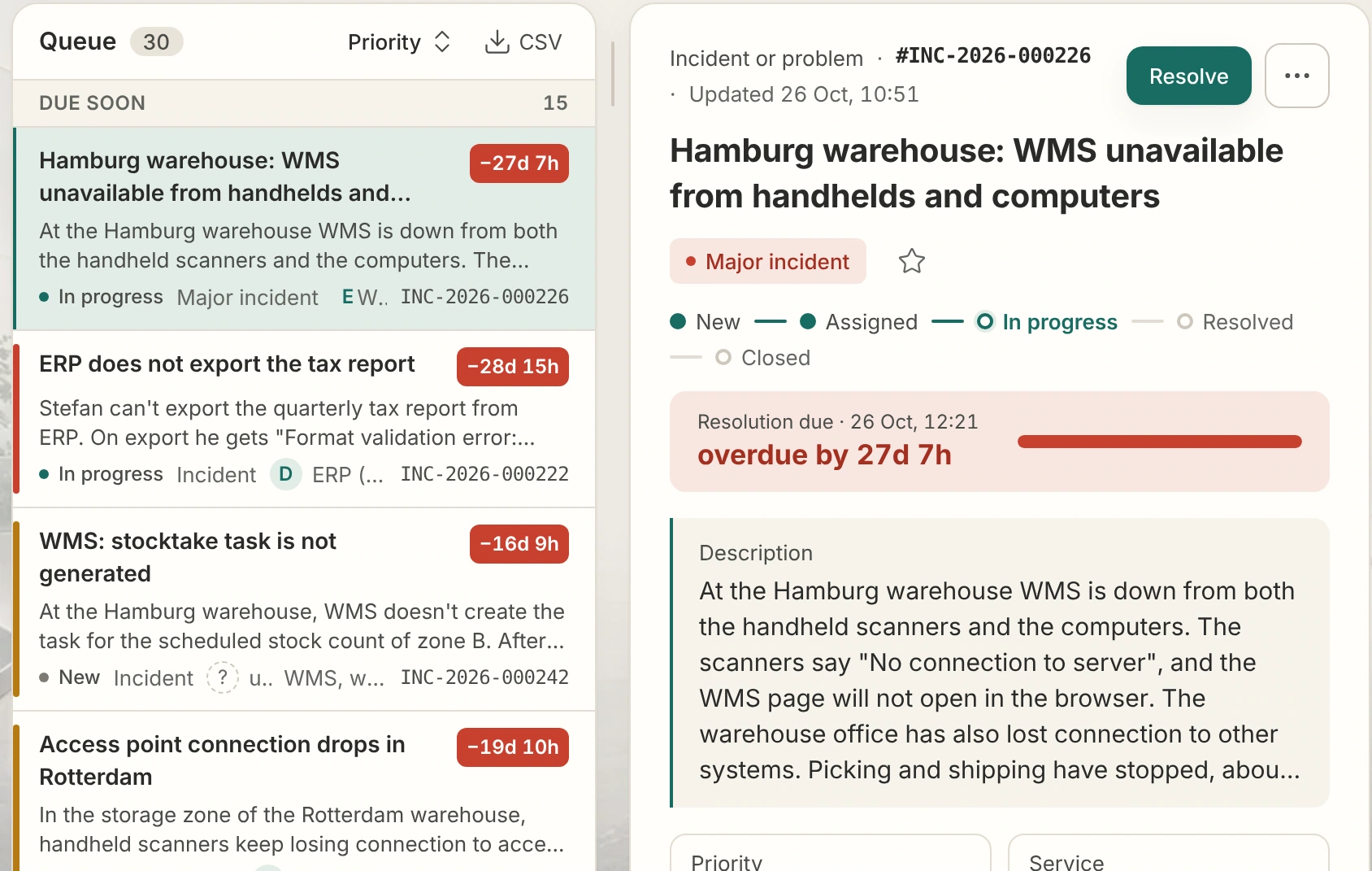
CMDB
Open the WMS dependency map and follow it down to the servers. The same map tells you which services your fix might touch.
ITSM + Release
If the recovery needs a change, write down the risk, who approved it and how you’d roll back. Then check the release is ready before it goes out.
GRC
At the next internal review, open the original incident, the change linked to it and the go-live decision. Anyone can see who signed off and why.
You don’t need to be an ITIL expert. Pick the situation closest to your own job and see which products help and how to check the result in two weeks.
IT leaders
Put cost, risk and service impact side by side before the steering meeting.
Service desk
The next shift sees what was reported, what was tried and what’s next.
Security and compliance
Every exception has a reason, an end date and someone who checked.
Infrastructure
Tell a real trend from a short spike before touching production.
Business operations
Renewal talks start from service history, supplier terms and real costs.
Service providers
Each client gets its own organisation, data and status page.
No sales call, no long project. You can see whether BeaverFlow suits your team in an afternoon.
1
Registration opens soon. We’ll write once, the moment you can sign up, and that’s it.
2
The trial gives you 14 days of the Business plan with all 27 products. Invite someone who asks, someone who fixes and someone who approves.
3
Load the demo company to look around, then take one request of your own from the first report to a closed record. Each product page suggests an exercise.
ITIL 4 and ISO
Most teams meet ISO twice: in a panic a month before the audit, and in relief the day after. In between, the evidence quietly goes stale.
BeaverFlow checks two things for every requirement, every day. Is the process set up? And is anyone actually using it? A service with an owner but no review for six months shows up as a gap, with a link to the chapter that explains how to close it.
The readiness score is a guide, not a certificate. 75% tells you stage one is within reach, 90% with no open gaps is where stage two starts, and the certification decision always belongs to an accredited body. What you get is time: you see a specific gap in March, not in the auditor’s report in October.
Everything in the Business plan, for two weeks, with nothing to install.
Registration opens on 20 December 2026. Leave your email and we’ll tell you the moment you can sign up.